


What Is Spinal Decompression Therapy and Does It Work?
 John Coury, D.O
July 20, 2026
John Coury, D.O
July 20, 2026
If you are living with radiating back pain, leg numbness, or a herniated disc that has not responded to rest or medication, you may have come across spinal decompression therapy as a potential solution. It is one of the most searched non-surgical options for spine pain, and also one of the most misunderstood.
This blog cuts through the confusion and gives you a clear picture of what this therapy actually involves, who it helps, and what the evidence says.
How Non-Surgical Spinal Decompression Treats Disc Pain?
Non-surgical spinal decompression is a motorized traction-based therapy that gently stretches the spine to relieve pressure on compressed discs and nerves. It is designed to treat conditions like herniated discs, degenerative disc disease, sciatica, and spinal stenosis, without surgery or injections. Spinal decompression for a herniated disc has shown meaningful results in clinical settings, with many patients experiencing significant pain reduction after a structured course of treatment.How Does Non-Surgical Spinal Decompression Work on the Spine
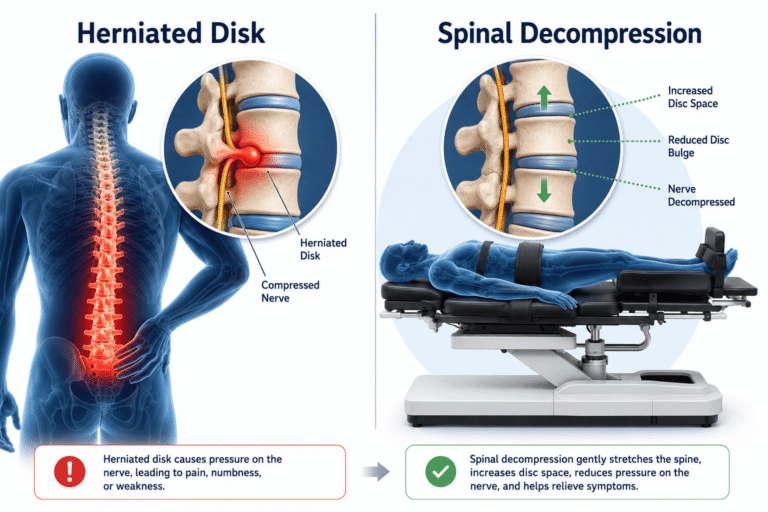
- You are secured to a motorized table, either in a face-up or face-down position, depending on the area being treated.
- The table applies a carefully calibrated distraction force that separates the vertebrae at the targeted disc level.
- This separation creates negative intradiscal pressure, a vacuum effect that draws herniated or bulging disc material back toward the center.
- The negative pressure also encourages the flow of oxygen, nutrients, and fluids into the disc, promoting natural healing.
- Sessions alternate between distraction and relaxation phases, repeated in cycles throughout the treatment.
This mechanism is what sets spinal decompression apart from simple stretching or manual traction. The computer-controlled precision allows the body to relax rather than resist the pull, making the therapy both comfortable and effective for the right patients.
Spinal Decompression Therapy Success Rates and What Clinical Studies Show
One of the most common patient questions is whether this therapy actually delivers results, and for the right candidates, the evidence is encouraging.
Clinical studies on non-surgical spinal decompression report meaningful pain and function improvement in many patients with disc-related conditions, though the quality of that evidence varies – some individual studies show strong results, while independent reviews of the overall research note it’s still limited compared to other back pain treatments. That’s why candidacy evaluation matters more than the therapy alone.
Spinal decompression therapy success rates are highest when:
- The patient is a confirmed candidate based on imaging (MRI or X-ray)
- The full recommended number of sessions has been completed; partial treatment produces partial results
- Decompression is combined with complementary therapies such as stretching, heat, or electrical stimulation
- The underlying condition is disc-related rather than structural (such as fracture or severe arthritis)
It is important to note that spinal decompression is not a guaranteed cure, and it is not appropriate for every spine condition. Candidacy evaluation by a qualified spine specialist is essential before beginning treatment.
How Many Sessions of Spinal Decompression Are Needed, and How Long Does It Take to Work
Patients often want to know how quickly they will feel results and how long the process takes. The honest answer is that it varies, but here are typical parameters:
Number of sessions: Most treatment protocols involve 15 to 30 sessions over 4 to 8 weeks. How many sessions of spinal decompression are needed depends on the severity and chronicity of the condition.
Session length: Each session typically lasts 30 to 45 minutes.
When results appear: Some patients notice relief within the first few sessions. For others, improvement builds progressively over several weeks. How long it takes for spinal decompression to work generally ranges from 2 to 6 weeks of consistent treatment.
Permanence of relief: Patients who complete the full protocol and follow through with home exercises and lifestyle recommendations have the best chance of achieving permanent relief from spinal decompression therapy, though some may need periodic maintenance sessions.
Exercises to Do After Spinal Decompression Therapy
Complementary exercises reinforce the gains made during treatment and reduce the risk of recurrence. Your care team at STL Spine Care may recommend:
- Pelvic tilts and gentle lumbar stabilization exercises to strengthen the core without loading the spine.
- Cat-cow stretches and knee-to-chest stretches to maintain disc mobility.
- Walking, a low-impact activity, to promote circulation and spinal fluid movement.
- Prone press-ups (for appropriate patients) to encourage disc centralization.
Avoid high-impact activities, heavy lifting, or prolonged sitting immediately following sessions. Your care team will give you a specific post-treatment exercise plan tailored to your condition.
Can I Get Spinal Decompression for Spinal Stenosis and Other Conditions
Spinal decompression is most commonly associated with herniated discs, but it is also used for a broader range of spinal conditions. Candidates who typically benefit include patients with:
- Herniated or bulging discs (cervical or lumbar).
- Degenerative disc disease causes chronic back or neck pain.
- Sciatica from lumbar nerve root compression.
- Posterior facet syndrome.
- Spinal stenosis, when the narrowing is disc-related rather than caused by bone overgrowth or instability.
Spinal decompression is not recommended for patients who are pregnant, have spinal fractures, severe osteoporosis, spinal tumors, advanced spinal instability, or have hardware such as screws or rods from prior fusion surgery. A thorough evaluation and imaging review are required before treatment begins.
Conclusion
Non-surgical spinal decompression is a clinically supported, drug-free option for patients dealing with disc-related back and neck pain. It works by creating the right conditions for natural disc healing, and when applied to the right patient with the right protocol, it can deliver meaningful, lasting relief.
The key is starting with an accurate diagnosis and an honest evaluation of whether you are a strong candidate. If you are exploring spinal decompression in St. Louis, STL Spine Care’s team of non-surgical spine specialists is ready to assess your condition and build a treatment plan with real outcomes in mind.
Schedule your consultation today to explore your non-surgical path to a pain-free life.
Frequently Asked Questions
What is spinal decompression therapy for herniated discs, exactly?
How long does it take for spinal decompression to work?
Can spinal decompression provide permanent relief?
For many patients, yes. By addressing the underlying disc compression rather than just masking the symptoms, decompression can provide long-lasting results. To maintain these results, we recommend following a specific core-strengthening program after your sessions are complete.
How many sessions will I need at STL Spine Care?
A typical treatment plan at STL Spine Care consists of 15 to 30 sessions administered over several weeks. Consistency is key to the “vacuum effect” working successfully, so completing the full protocol is essential for the best outcome.
How do I know if I am a candidate for spinal decompression at STL Spine Care?
If you have a herniated disc, sciatica, or degenerative disc disease and want to avoid surgery, you may be an ideal candidate. We determine eligibility through a thorough review of your MRI or X-rays and a physical exam to ensure the treatment is safe and effective for your specific condition.
- How Non-Surgical Spinal Decompression Treats Disc Pain?
- How Does Non-Surgical Spinal Decompression Work on the Spine
- Spinal Decompression Therapy Success Rates and What Clinical Studies Show
- How Many Sessions of Spinal Decompression Are Needed, and How Long Does It Take to Work
- Can I Get Spinal Decompression for Spinal Stenosis and Other Conditions
- Conclusion
- Frequently Asked Questions