

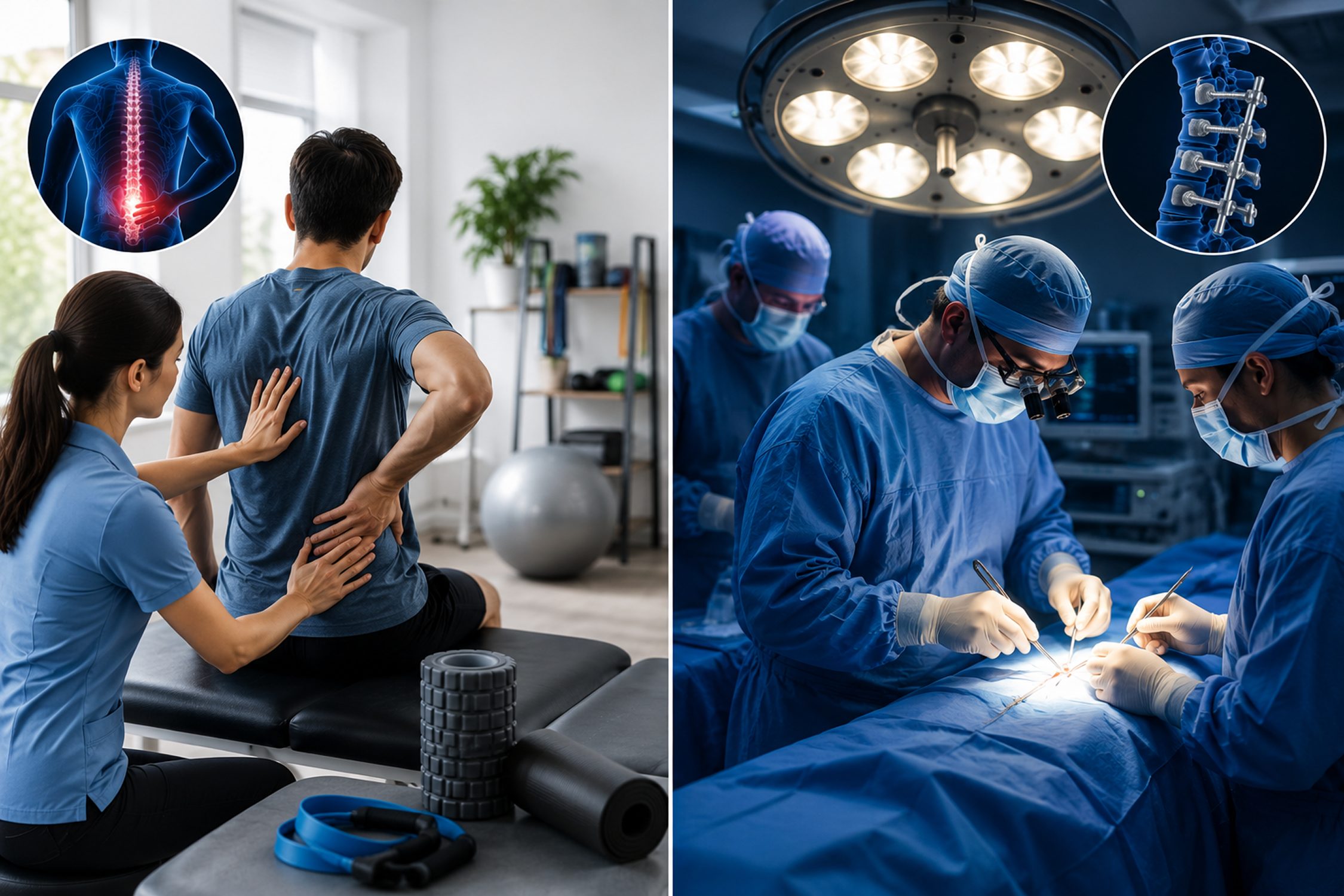
Non-Surgical vs Surgical Spine Treatments: How to Decide
 John Coury, D.O
August 21, 2026
John Coury, D.O
August 21, 2026
Severe back or neck pain forces a question most patients aren’t prepared for: Can this be treated conservatively, or is surgery truly necessary?
The right path forward depends on your specific diagnosis, symptom duration, and how your spine responds to non-surgical care. This guide breaks down when conservative therapies work, when surgical intervention becomes necessary, and how spine specialists evaluate your treatment plan.
CRITICAL SAFETY WARNING: When to Seek Immediate Emergency Care
While most spine conditions can be safely managed without an operation, seek immediate emergency medical evaluation if your back or neck pain is accompanied by:
- Sudden loss of bowel or bladder control
- Progressive leg weakness or “foot drop” (inability to lift the front of your foot)
- Numbness in the groin or “saddle” area
- Constant, severe pain accompanied by unexplained fever or chills
These are red-flag indicators of acute nerve compression or spinal infection, requiring urgent surgical evaluation.
Conditions That Respond Well to Non-Surgical Treatment
The vast majority of spinal conditions resolve successfully without an operation, particularly when there is no severe structural instability or progressive nerve damage.
Below are the conditions for which conservative care is most commonly recommended:
| Condition | Symptoms |
|---|---|
| Mild disc bulge | Mild continuous pain in the neck and lower back, worsens while bending |
| Cervical muscle strain | Neck tightness and soreness that makes turning difficult |
| Mild sciatica | Tingling pain in the lower back, buttocks, and legs |
| Spinal arthritis | Stiffness or lower back pain that worsens in the morning or after rest |
| Mild disc herniation | Sharp pain in the back while coughing or sneezing, accompanied by numbness |
Core Non-Surgical Treatment Pathways
Non-surgical care focuses on reducing active inflammation, improving spinal mechanics, and relieving pressure on surrounding nerves. Specialists usually combine these options for best results:
Targeted Physical Therapy: Focuses on rebuilding core stability, improving hip flexibility, and correcting movement mechanics that overload the spine.
Targeted Medications: Short-term use of non-steroidal anti-inflammatory drugs (NSAIDs) or muscle relaxants reduces acute flare-ups to support rehabilitation.
Chiropractic Care: Gentle manual adjustments restore mobility in restricted facet joints and ease localized muscular tension.
Epidural Steroid Injections: Image-guided injections deliver anti-inflammatory medication directly around irritated nerve roots, providing significant pain relief when physical therapy alone stalls.
When Spine Surgery Becomes Necessary
Spine specialists treat surgery as a last resort, recommending it only after conservative care has been given adequate time to work. If symptoms persist or worsen despite consistent non-surgical treatment, surgical evaluation becomes necessary.
The following conditions and symptoms most commonly indicate that surgery may be required:
| Condition | Symptoms |
|---|---|
| Severe herniated disc | Shooting pain down the arm or leg, worsening despite weeks of conservative care |
| Spinal stenosis | Progressive leg weakness, cramping, or difficulty walking that worsens with standing |
| Nerve compression (radiculopathy) | Persistent numbness, tingling, or progressive muscle weakness in the arms or legs |
| Unstable vertebral segments (spondylolisthesis) | Severe, recurring back pain with instability, worsening with movement |
| Cauda equina syndrome | Sudden loss of bowel or bladder control – a neurological emergency requiring urgent surgery |
| Spinal infection | Constant severe back pain with unexplained fever, night sweats, or rapid neurological decline |
Important: No single symptom alone determines the need for surgery. A spine specialist will assess your imaging, symptom duration, and response to conservative care before making any recommendation.
Surgical Options & Expected Recovery Timelines
When surgery is required, modern spine care prioritizes minimally invasive techniques whenever possible. Smaller incisions mean less muscle disruption, lower complication risks, and faster recovery times.
Laminectomy (Decompression Surgery): Removes the bone or tissue causing pressure, creating more room for compressed spinal nerves.
Discectomy: Removes the portion of the disc pressing on the nerve – highly effective for herniated discs.
Microdiscectomy: A minimally invasive form of discectomy using a smaller incision, resulting in less muscle disruption and faster recovery.
Artificial Disc Replacement: Recommended when a damaged disc causes persistent pain and limits movement.
Spinal Fusion: Stabilises unstable spine segments by joining two or more vertebrae together.
Minimally Invasive Surgery: A modern surgical approach that treats spinal conditions through smaller incisions, reducing muscle disruption and speeding recovery.
Recovery timelines procedure type:
- Microdiscectomy: light activity within 2–4 weeks, full function by 6–12 weeks
- Other minimally invasive procedures: 4–6
- weeksSpinal fusion: several months, with staged return to full activity.
A Framework for Making Your Decision : Surgical Or Non-Surgical Treatment?
When deciding between conservative therapy and surgical evaluation, keep these four guidelines in mind:
Start with Conservative Care: Give non-surgical treatments 6 to 12 weeks to work unless red-flag emergency symptoms are present.
Escalate When Symptoms Plateau: Persistent numbness, worsening weakness, or inability to perform daily tasks mean symptom management is no longer enough.
Let Advanced Imaging Guide You: High-resolution MRIs or CT scans, evaluated alongside your physical exam, confirm whether a structural defect exists that surgery can fix.
Factor in Your Personal Health: Age, bone density, overall physical health, and activity goals all play a major role in determining whether surgery or conservative management offers the safest path.
Conclusion
Persistent neck or back pain, numbness, tingling, or stiffness that limits daily movement are all reasons to seek a professional evaluation. Delaying assessment allows spinal conditions to progress, often narrowing the window for effective non-surgical care.
At STL Spine Care, our spine specialists examine your symptoms, lifestyle, and recovery goals before recommending either surgical or non-surgical treatment. When surgery becomes necessary, we use advanced diagnostic tools and modern surgical techniques to perform procedures with greater precision – reducing recovery time and helping you return to daily activities sooner.
Frequently Asked Questions
Can a herniated or slipped disc actually heal without surgery?
Yes. The vast majority of herniated discs resolve without surgery over several weeks to months. Targeted physical therapy combined with anti-inflammatory treatments allows the body to naturally reabsorb the herniated tissue.
How long should I try physical therapy before considering spine surgery?
What are my best non-surgical options for chronic back or neck pain?
How do I know when spine surgery goes from "optional" to "necessary"?
What makes minimally invasive spine surgery different from traditional surgery?
Minimally invasive surgery uses smaller incisions and specialized micro-instruments to access the spine without cutting or detaching major supporting muscles. For patients, this translates to less post-operative pain, reduced blood loss, lower infection risk, and a significantly faster return to daily life.
Can I visit a St. Louis spine care clinic just for a second opinion on surgery?
Yes. Seeking a second opinion is a common and recommended step before committing to surgery. At STL Spine Care, our specialists independently review your MRI scans, treatment history, and current symptoms to help you determine whether surgery is truly necessary or if an advanced non-surgical alternative is still viable.