

Spinal Fusion Surgery: Benefits, Risks, and Recovery Explained
 John Coury, D.O
July 14, 2026
John Coury, D.O
July 14, 2026
Chronic back pain that does not respond to physical therapy, injections, or medication can be debilitating. For some patients, spinal fusion surgery is the step that finally delivers lasting relief. But it is also a significant decision, one that deserves a clear, honest explanation of what it involves and what to realistically expect from the process.
Is Spinal Fusion Surgery the Right Choice for You?
Spinal fusion permanently joins two or more vertebrae to eliminate painful motion at an unstable or damaged spinal segment. It is most commonly recommended for conditions like degenerative disc disease, spondylolisthesis, spinal stenosis, and fractures.The procedure is typically performed under general anesthesia and takes 2 to 4 hours, depending on how many levels are being fused. Spinal fusion recovery varies by procedure complexity, but most patients return to light daily activities within 3 to 6 weeks and achieve full recovery in 6 to 12 months.
Benefits of Spinal Fusion for Degenerative Disc Disease and Spinal Instability
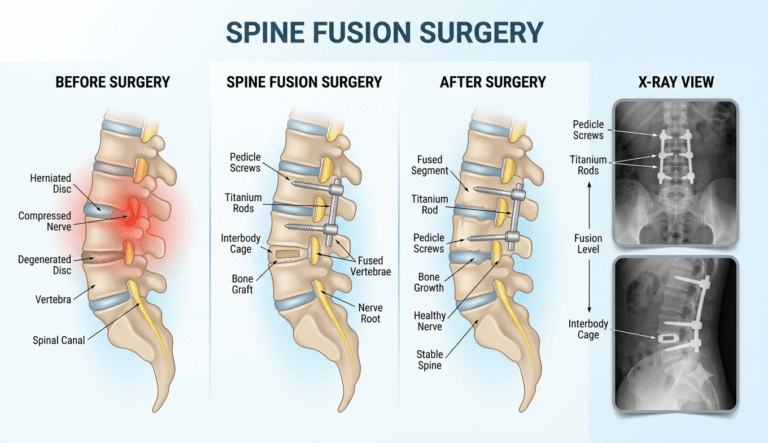
Spinal fusion is not a one-size-fits-all solution, but for the right patient, the benefits are substantial and long-lasting. Understanding what the procedure can and cannot achieve helps set realistic expectations.
Permanent pain relief: By eliminating movement at a damaged disc level, fusion removes the friction and nerve irritation causing chronic pain.
Spinal stability: Fusion can stop spondylolisthesis progression, a condition where one vertebra slips forward over another, preventing further nerve damage.
Restored function: Many patients regain the ability to stand, walk, and participate in daily activities that pain had previously made impossible.
Structural correction: In cases of deformity such as scoliosis or kyphosis, fusion corrects alignment and prevents worsening curvature.
Alternative to ongoing treatment: For patients who have exhausted conservative care, fusion can be more effective long-term than repeated injections or pain management alone.
For patients asking whether spinal fusion is better than artificial disc replacement, the answer depends on the number of levels affected, bone quality, and overall spinal alignment. our team walks through both during your evaluation and recommends whichever offers the better long-term outcome for your specific case.
Is Spinal Fusion Safe for Older Adults and All Patients?
Yes, for most patients- age alone is not a disqualifying factor. Bone density, cardiovascular health, and overall medical condition matter far more than age when determining candidacy. Every surgical procedure carries risk, and spinal fusion is no exception.
Common risks include:
- Infection at the incision site or around the spinal hardware
- Blood clots, particularly in the legs (deep vein thrombosis)
- Nerve injury resulting in weakness, numbness, or rarely paralysis
- Pseudarthrosis (failed fusion), where the bones do not fully fuse
- Adjacent segment disease, where the disc above or below the fusion level degenerates faster due to added stress
- Hardware complications, including loosening or breakage of rods or screws
Thorough pre-operative health screening is what makes fusion safe for older adults specifically. The success rate of lumbar spinal fusion for chronic back pain is approximately 70 to 90 percent for achieving solid bone fusion; since a successful fusion doesn’t always guarantee complete symptom relief, with outcomes improving significantly when surgery is performed by experienced spine specialists.
Spinal Fusion Recovery Timeline: What to Expect Week by Week
Spinal fusion recovery is a gradual process. Unlike some minimally invasive procedures, fusion requires the body to grow new bone, which takes time. Here is a general spinal fusion recovery timeline:
- Days 1–3: Hospital stay for monitoring. Pain is managed with medication. You will be assisted in walking short distances.
- Weeks 1–4: Home recovery. Light walking is encouraged. No bending, lifting, or twisting. Wound care and medication management are the focus.
- Weeks 4–8: Physical therapy begins. Patients gradually increase walking distance and mobility. Most return to desk work during this phase.
- Months 3–6: Bone fusion continues progressing. Patients gradually resume moderate physical activity with their surgeon’s clearance.
- Months 6–12: Full recovery for most patients. Return to physically demanding work or exercise requires imaging to confirm solid fusion.
Sleeping Comfortably After Spinal Fusion Surgery
Sleep is critical to recovery, but it can be difficult in the early weeks. Recommended positions include lying on your back with a pillow under your knees, or on your side with a pillow between your knees. Avoid sleeping on your stomach entirely. A recliner is often more comfortable than a flat bed in the first two weeks.
How to Prepare Your Home for Spinal Fusion Recovery
- Move commonly used items to counter height to avoid bending
- Set up a recovery station with medications, water, phone, and remote within reach
- Install grab bars in the shower and near the toilet
- Remove loose rugs or tripping hazards from walkways
- Arrange for help with cooking, laundry, and transportation for the first 2 to 4 weeks
Where to Get Minimally Invasive Spinal Fusion in St. Louis
Not all spinal fusion procedures require large incisions or extended hospital stays. Advances in surgical technique have made minimally invasive spinal fusion a viable option for many patients. Compared to traditional open fusion, MISF involves smaller incisions, less muscle disruption, reduced blood loss, and faster recovery, often with equivalent long-term outcomes.
The latest advancements in spinal fusion technology include robotic-assisted surgery, intraoperative imaging for real-time screw placement verification, and biologics that enhance bone growth and fusion success rates. These tools improve precision and reduce the margin for error significantly.
STL Spine Care brings these capabilities to patients across the St. Louis region. Our spine-focused team evaluates candidates carefully to determine whether open or minimally invasive fusion is the appropriate approach, and we never recommend surgery when conservative options remain viable.
Conclusion
Spinal fusion surgery is a proven, effective solution for patients dealing with structural spinal instability, degenerative disc disease, and conditions that have not responded to conservative care. Like any major procedure, it requires careful patient selection, experienced surgical technique, and a committed recovery plan.
Understanding the full spinal fusion recovery process, from the first days post-surgery to returning to full activity, helps patients approach it with confidence rather than apprehension. If you are exploring your options for spinal fusion in St. Louis, STL Spine Care is here to give you a straightforward, expert evaluation and help you make the decision that is right for your spine and your life.
Request a consultation with STL Spine Care, and get the clarity you need to move forward.
Frequently Asked Questions
What are the benefits of spinal fusion for degenerative disc disease specifically?
Can spinal fusion stop spondylolisthesis from getting worse?
Do I need spinal fusion or a diskectomy?
How long after spinal fusion can I bend and lift normally?
Is spinal fusion surgery safe for older adults?
- Is Spinal Fusion Surgery the Right Choice for You?
- Benefits of Spinal Fusion for Degenerative Disc Disease and Spinal Instability
- Is Spinal Fusion Safe for Older Adults and All Patients?
- Spinal Fusion Recovery Timeline: What to Expect Week by Week
- Where to Get Minimally Invasive Spinal Fusion in St. Louis
- Conclusion
- Frequently Asked Questions